
How Long Will a Power Station Run a Microwave?
Most microwaves draw 1,000-1,800W from the wall. Honest runtime math for 500-3,840Wh stations, why short bursts let small batteries last days, and sizing picks.
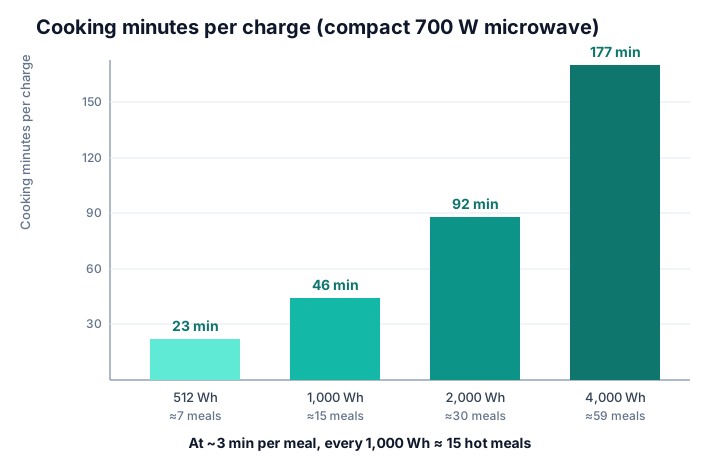
The short answer: yes, easily — and for far more meals than you’d expect. A typical countertop microwave pulls 1,000–1,800W from the wall while it cooks, so output-wise you need a station with at least a 1,000–1,800W inverter. But here’s the part most sizing guides miss: a microwave only draws power for the 2–6 minutes it’s actually cooking. A 1,000Wh power station delivers roughly 46 minutes of total cooking time with a compact 700W-output model — which, at ~3 minutes per meal, is about 15 hot meals per charge. Run three reheated meals a day and that same battery covers a five-day outage of cooking. Compare that with a space heater, where 1,000Wh buys barely half an hour of warmth, and the microwave quietly becomes one of the best appliance investments in a battery-backed blackout.
This page runs the honest math: what a microwave actually draws (it’s not the number on the front), the runtime formula, cooking minutes by battery size, and the sizing mistakes to avoid. We’ve already covered the chest freezer and the furnace blower — pair this page with those two and your entire outage kitchen is planned. And when the cooking is sorted, the TV and router stack is the cheapest morale your battery can buy.
The one number to check before anything else: the cooking watts printed on the door are not what the microwave pulls from the outlet. Input draw is typically 40–50% higher than the cooking rating. Check the label on the back of the unit — it says “Power Consumption” — before matching it to any power station’s continuous output rating.
Why microwaves list two wattages (and why it matters)
Microwave ovens are the rare appliance where the headline number on the front of the door is not the number that matters for your battery. Manufacturers rate microwaves by their cooking output — the radio-frequency power the magnetron tube actually delivers to your food. Federal test procedures and energy labels use this cooking-wattage rating, which is why every box and spec sheet leads with it.
But the magnetron, like any RF generator, wastes energy converting wall power into cooking power. Magnetron efficiency typically lands around 60–70%, which means the wall draw — the number your power station actually has to supply — is the cooking rating divided by roughly 0.65. Add the turntable motor, the cavity light, the control board, and the cooling fan (another 30–60W combined), and you get the real input draw.
| Microwave class | Cooking output (front panel) | Typical wall draw (input) | Where it’s rated |
|---|---|---|---|
| Compact countertop | 600–800W | ~950–1,150W | Dorms, offices, small kitchens |
| Mid-size countertop | 900–1,000W | ~1,350–1,500W | The most common household size |
| Full-size countertop | 1,100–1,250W | ~1,650–1,800W | Family kitchens |
| Over-the-range / built-in | 1,000–1,100W | ~1,500–1,700W | Mounted units, often with vent fans |
Figures are typical ranges from manufacturer rating labels and magnetron conversion efficiency; check the “Power Consumption” line on your unit’s rear label for the exact number. The practical consequence: a “1,000W microwave” is really a ~1,450W appliance, and a station with a 1,000W inverter can only reliably run the compact class. That single distinction prevents the most common sizing mistake on this topic.
Does a microwave need surge headroom?
Far less than you’d think. Unlike a freezer or refrigerator compressor — which can spike to 3–7× its running draw for a fraction of a second at startup — a microwave’s magnetron starts through its high-voltage transformer with only a brief, modest inrush, typically well under 1.5× its steady-state draw. The turntable motor and cooling fan add a few tens of watts with no meaningful spike.
What this means in practice: surge rating is a non-issue for microwaves. The spec that matters is a power station’s continuous output, and the math is simple — the station’s continuous rating must exceed your microwave’s input watts with headroom to spare. Any station rated 1,800W+ continuous (the EcoFlow DELTA 2, Anker SOLIX C1000, and Bluetti AC180 all qualify) runs any countertop microwave made. A station rated 1,000W continuous is fine for a compact 700W-output unit but is flirting with its limit; a station rated 600W or less — the small units in the 200–300W inverter class — cannot run a microwave at all, so don’t let a 256Wh brick’s product page convince you otherwise.
The runtime formula
Total cooking time (hours) = (Battery Wh × 0.95 × 0.85) / Microwave input watts

  0.95 = LiFePO4 usable-capacity factor
  0.85 = inverter conversion loss (AC output)
Worked examples for a 1,000Wh LiFePO4 station (≈808Wh usable after derating):
- Compact 700W-output microwave (~1,050W input): 808 / 1,050 = ~0.77 hours ≈ 46 minutes of total cooking
- Common 1,000W-output microwave (~1,450W input): 808 / 1,450 = ~0.56 hours ≈ 33 minutes
- Full-size 1,250W-output unit (~1,800W input): 808 / 1,800 = ~27 minutes
Unlike the space heater page, this is not the whole story — because nobody runs a microwave for 46 continuous minutes. The burst pattern is where the real answer lives, and it’s covered in the next section. Run your own appliance’s numbers with the Runtime Calculator.
Total cooking time by power station size
Estimated total cooking minutes per full charge, using the derating factors above:
| Battery capacity | Usable Wh | Compact (1,050W in) | 1,000W class (1,450W in) |
|---|---|---|---|
| 256Wh (mini) | ~197 | can’t run one (300W inverter) | can’t run one |
| 512Wh (compact station) | ~404 | ~23 min | ~17 min |
| 716Wh | ~591 | ~34 min | ~25 min |
| 1,000Wh (mid-size) | ~808 | ~46 min | ~33 min |
| 2,000Wh (large) | ~1,615 | ~92 min | ~67 min |
| 3,000Wh (expanded) | ~2,423 | ~138 min | ~100 min |
| 4,000Wh+ (whole-home) | ~3,101 | ~177 min | ~128 min |
And with specific popular models (usable Wh per manufacturer spec sheets, derated the same way):
| Power station | Usable Wh | Compact microwave (1,050W) | 1,000W-class (1,450W) |
|---|---|---|---|
| EcoFlow DELTA 2 (1,024Wh, 1,800W AC) | ~827 | ~47 min | ~34 min |
| Anker SOLIX C1000 (1,056Wh, 1,800W AC) | ~853 | ~49 min | ~35 min |
| Bluetti AC180 (1,152Wh, 1,800W AC) | ~930 | ~53 min | ~38 min |
| Bluetti AC200P (2,000Wh, 2,000W AC) | ~1,615 | ~92 min | ~67 min |
| Anker SOLIX F3800 (3,840Wh, 6,000W AC) | ~3,101 | ~177 min | ~128 min |
One sizing trap deserves its own line: a 716Wh unit like the Bluetti EB70 pairs a 1,000W inverter with ~591Wh of usable capacity — about 34 minutes of compact-microwave cooking on paper, but a compact unit drawing 1,050W sits right at the inverter’s ceiling. For microwave duty, treat 1,000W continuous as the absolute floor and 1,300W+ as the comfortable minimum. The 1,800W-inverter mid-size class is where microwave backup stops being a compromise.
The burst-load advantage: think meals, not hours
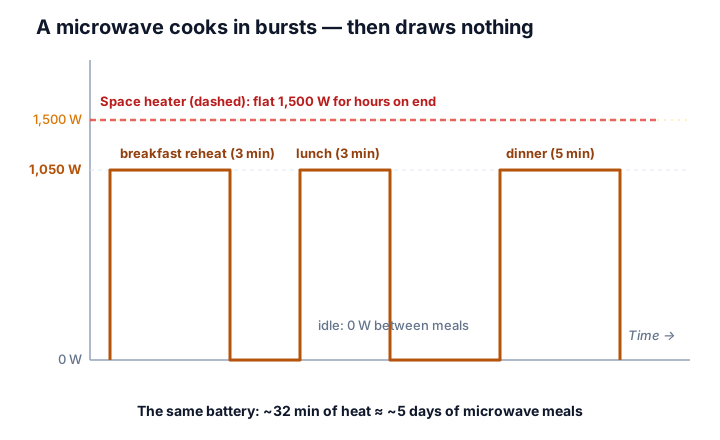
This is the insight that changes the whole picture. A space heater runs flat-out for as long as you let it; a microwave draws nothing between meals. Its duty cycle is dictated by mealtime, not by weather. Three reheated meals a day at ~3 minutes each is just 9 cooking minutes and ~0.16kWh per day at compact-microwave draw.
Do the division:
- 1,000Wh station: ~46 cooking minutes ≈ 15 meals ≈ 5 days at 3 meals/day
- 2,000Wh station: ~92 minutes ≈ 30 meals ≈ 10 days
- 512Wh compact station: ~23 minutes ≈ 7 meals ≈ 2 days
That’s the headline most “can a power station run a microwave” answers bury: a mid-size 1,000Wh station covers a week of cooking for a household that’s willing to reheat rather than cook from scratch — and reheating is exactly what you do in an outage, because the stove and oven are out with the grid. Add a chest freezer to the same plan (its cycling draw is similarly gentle on batteries) and the freezer-plus-microwave pair becomes the backbone of a multi-day outage kitchen: keep the frozen food frozen, reheat it meal by meal.
Two habits stretch it further:
- Batch your reheats. Back-to-back items keep the cavity and magnetron warm; the second and third plates cost slightly less energy than cold starts. Reheating six portions in one session beats three sessions of two.
- Cook once, reheat all day. If you have a gas stove, boil a big pot once and keep it warm; the microwave’s job is then sides and leftovers, and your battery is freed up for the freezer and lights.
Where solar recharge fits in
The microwave’s low daily average (~0.16kWh/day for the three-meals-a-day pattern) is small enough that even a modest panel meaningfully extends the clock. A 200W panel in fair post-storm conditions yields roughly 0.6–1.0kWh over a day — three to six times the microwave’s daily consumption. In other words, on a sunny day, the panel alone can pay for all your cooking, while the battery covers the overcast days and the evening meals.
That’s the opposite conclusion from the space heater page, where a 400W array couldn’t even feed 1,500W of continuous element. Burst loads are the friend of solar; continuous resistive loads are its enemy. For the full charge-time math on the battery side, see the solar recharge time calculator.
The inverter-microwave footnote
A small minority of microwaves (most famously certain Panasonic models) use true inverter power supplies instead of a heavy transformer. They modulate cooking output smoothly — “50% power” means a continuous half-power draw rather than pulses of full power — which slightly improves energy efficiency for long simmers and, usefully for this page, lowers their average draw at reduced settings. A 1,000W-output inverter microwave at 60% power draws proportionally less than a transformer unit cycling on and off at full input. It’s a nice-to-have, not a requirement; every runtime figure on this page holds for either type at full power.
The pure-sine-wave question
A magnetron doesn’t care much about waveform, but the appliance around it does: the control board, the touch panel, the turntable motor, and the cooling fan are all small electronics that misbehave on cheap modified-sine power — buzzing, flickering displays, or a turntable that stutters. Every power station recommended here outputs a clean pure sine wave, so the point is moot for these picks — but if you’re pairing a microwave with an older budget inverter or a modified-sine generator adapter, expect the electronics, not the magnetron, to complain first.
Picks by scenario
The outage-kitchen core → EcoFlow DELTA 2 / Anker SOLIX C1000 / Bluetti AC180
A ~1,000Wh class station with a 1,800W inverter is the sweet spot: 46–53 minutes of compact-microwave cooking (15+ meals), enough inverter headroom for any countertop microwave plus a freezer on the same unit, and fast enough recharging to bounce back between storm systems. The AC180 carries the most battery of the trio; the DELTA 2’s expandability and the C1000’s fast AC recharge are the tiebreakers.
Multi-day comfort → Bluetti AC200P
At 2,000Wh, the AC200P holds roughly 92 cooking minutes — a full month of meals — and its 2,000W inverter runs a full-size 1,250W-output microwave plus the freezer, lights, and router simultaneously. If your outage baseline is “a week or more,” this is the class that stops you from thinking about the battery at all.
Whole-home backup → Anker SOLIX F3800
The F3800’s 3,840Wh and 6,000W inverter run the microwave, the freezer, the furnace blower, and everything else without triage — around 177 minutes of cooking and days of refrigeration per charge, expandable with extra batteries. This is the tier where the microwave becomes a rounding error in the outage plan.
What a microwave can’t replace in an outage
One honest caveat: reheating is not cooking. A microwave can’t boil pasta, fry eggs, or bake bread, and households that lean entirely on it tend to get creative with cold cereal by day three. If your outage plan includes actual cooking, the cleanest split is gas/propane stove for cooking, power station for the microwave’s reheating duty and the freezer — the stove burns fuel the battery can’t spare, and the battery handles the loads that genuinely need it. That division of labor is what turns a 1,000Wh station from “half an hour of heat and disappointment” into “five days of hot meals,” and it’s the single best framing decision in outage planning.