
How Long Will a Power Station Run a Space Heater?
A 1,500W heater is the most battery-hungry 120V appliance: honest runtime math for 500-3,840Wh stations, the thermostat trick, and cheaper ways to stay warm.
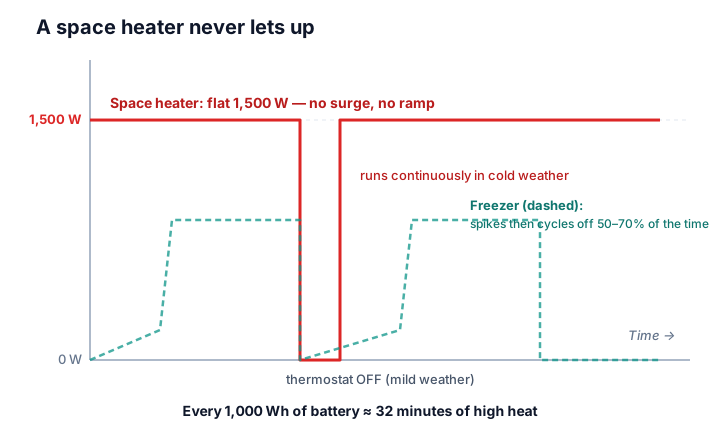
The short answer: yes, but for far less time than almost anything else you can plug in. A typical electric space heater draws 750W on low and 1,500W on high, continuously — it’s the single most battery-hungry appliance on a 120V outlet. A 1,000Wh power station realistically runs a heater on high for about half an hour; a 2,000Wh unit gets you roughly an hour; and even a 3,840Wh whole-home unit manages around two hours of continuous high heat. The good news is that a heater’s built-in thermostat cycles the element off when the room reaches temperature, so room-warming runtime stretches to 1.5–2.5× those continuous figures in mild weather — and there are much cheaper ways to stretch it further, covered below.
This page is the honest math. We’ve sized battery backup for a furnace, a chest freezer, and a pellet stove, and in every one of those cases the battery lasted longer than people expected. A space heater is the opposite case — and it’s better to know that before a storm than after.
Before you size anything: heat is where batteries go to die. Refrigeration, furnace blowers, and medical devices draw hundreds of watts and cycle. A space heater on high draws 1,500 watts and never stops. If your outage plan is “run a heater all night,” do the math on this page first — then consider the lower-wattage alternatives in the stretch-your-runtime section, which multiply your coverage several times over at zero cost.
What a space heater actually pulls
Almost every consumer space heater sold in the US has the same two settings, because they’re dictated by the household circuit, not the manufacturer:
| Heater type | Low setting | High setting | Startup surge | Notes |
|---|---|---|---|---|
| Ceramic fan-forced (typical 1,500W) | 750W | 1,500W | ~1.1× (negligible) | The standard tabletop/tower unit |
| Oil-filled radiator (1,500W) | 700–900W | 1,500W | ~1.05× (negligible) | Slowest to heat, longest to cool |
| Infrared / quartz (1,500W) | 750–1,000W | 1,500W | ~1.05× (negligible) | Radiant heat, warms objects not air |
| Small personal heater (200–500W) | — | 200–500W | ~1.1× | Desk units; rarely thermostat-cycling |
Why 1,500W is the ceiling: a standard 120V/15A household circuit carries about 1,800W, and electrical code treats continuous loads at 80% of the breaker rating — roughly 1,440W. Manufacturers responded by capping heater output at a 1,500W setting. So you will essentially never find a plug-in space heater rated above 1,500W, which conveniently bounds the math on this page.
Figures are typical ranges from manufacturer labels and standard 15A-circuit limits. The one number you don’t have to worry about is startup surge. A heating element is a pure resistive load — it draws essentially its rated wattage from the first millisecond. Fan-forced models add a small ~20–50W fan motor with a brief start spike, but that’s well within the headroom of any real power station. Unlike a freezer compressor or a well pump, a space heater will never overwhelm your inverter’s surge rating.
The runtime formula
Continuous runtime (hours) = (Battery Wh × 0.95 × 0.85) / Heater watts

  0.95 = LiFePO4 usable-capacity factor
  0.85 = inverter conversion loss (AC output)
Worked examples for a 1,000Wh LiFePO4 station (≈808Wh usable after derating):
- 1,500W heater on high: 808 / 1,500 = ~0.54 hours ≈ 32 minutes continuous
- 750W heater on low: 808 / 750 = ~1.1 hours continuous
That’s the entire story for a resistive load. There’s no cycling multiplier to lean on while the room is still cold — the element runs until the room warms up, and the battery runs until it’s empty. Run your own numbers with the Runtime Calculator.
Runtime by power station size
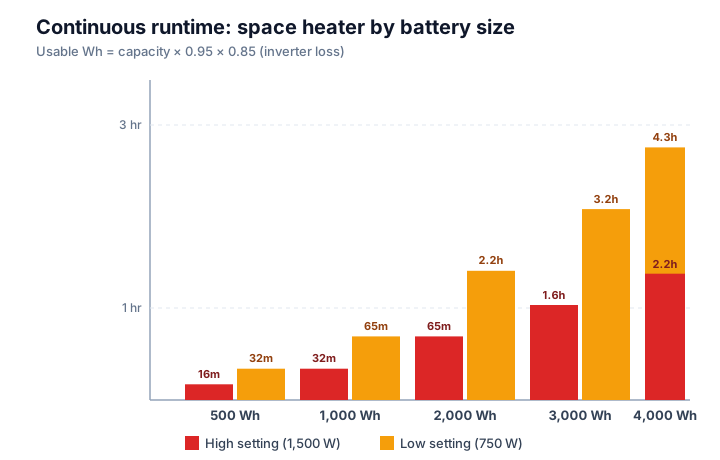
Estimated continuous runtime at the 1,500W high setting and the 750W low setting, using the derating above.
| Battery capacity | Usable Wh | Heater on high (1,500W) | Heater on low (750W) |
|---|---|---|---|
| 500Wh (compact) | ~404 | ~16 min | ~32 min |
| 1,000Wh (mid-size) | ~808 | ~32 min | ~65 min |
| 2,000Wh (large) | ~1,615 | ~65 min | ~2.2 hr |
| 3,000Wh (expanded) | ~2,423 | ~1.6 hr | ~3.2 hr |
| 4,000Wh+ (whole-home) | ~3,230 | ~2.2 hr | ~4.3 hr |
And with specific popular models (usable Wh per manufacturer spec sheets, derated the same way):
| Power station | Usable Wh | On high (1,500W) | On low (750W) |
|---|---|---|---|
| EcoFlow Delta 2 (1,024Wh) | ~827 | ~33 min | ~1.1 hr |
| Anker SOLIX C1000 (1,056Wh) | ~853 | ~34 min | ~1.1 hr |
| Bluetti AC180 (1,152Wh) | ~930 | ~37 min | ~1.2 hr |
| Bluetti AC200P (2,000Wh) | ~1,615 | ~65 min | ~2.2 hr |
| Anker SOLIX F3800 (3,840Wh) | ~3,101 | ~2.1 hr | ~4.1 hr |
The blunt takeaway: every 1,000Wh of battery buys about half an hour of high heat. A 1,500W heater eats a watt-hour every 2.4 seconds. If your mental model was “a big battery should run a heater for a whole night,” this is the page that saves you from that plan.
The thermostat trick: the one multiplier you get
Here’s the only good news. Almost every space heater has a thermostat dial or digital thermostat, and once the room reaches temperature the element clicks off. In genuinely cold weather it may never click off — but in mild conditions (say, holding 68°F in a 45°F room with decent insulation) the element can run only 40–60% of the time, stretching real runtime to about 1.5–2.5× the continuous figure:
- A 1,000Wh station on a 1,500W heater at 50% duty: ~65 min continuous → ~2 hours of room warming
- A 2,000Wh station at 40% duty: ~65 min continuous → ~2.7 hours of room warming
Three practical levers squeeze that further:
- Heat one room, one person. Close doors, seal the gap under them with a towel. A heater in a sealed bedroom beats a heater fighting an open floor plan.
- Run on low (750W). Halving the draw doubles runtime for only a few degrees of ceiling temperature — a low-setting heater in a small sealed room is usually more comfortable than a high-setting heater you keep shutting off.
- Let the thermostat do the work. Set it to a survivable 60–65°F, not 72°F. Every degree lower meaningfully lengthens the off-cycles. The goal in an outage is safety, not comfort.
Why solar doesn’t save you here
With a freezer, a 200–400W solar array can roughly offset a day’s consumption because the appliance’s average draw is low. A space heater has no average-draw trick to exploit: 1,500W on high exceeds what a 400W panel produces even in direct sun. A 400W panel in good conditions yields maybe 1.6–2.0kWh over a full day — the heater eats that in about an hour and twenty minutes. In an outage that typically comes with overcast skies, expect a fraction of that.
Solar still matters for everything else in your outage plan (see the freezer and furnace pages) — just not for resistance heating. That physics is unavoidable: electric resistance heat converts 100% of incoming electricity to warmth, which is efficient for the appliance and brutal for a battery.
Cheaper ways to stay warm: the wattage ladder
If the goal is “keep people warm through an outage” rather than “run this specific appliance,” drop down the wattage ladder. Each step buys roughly a proportional multiple of runtime:
| Heating approach | Typical draw | Runtime on a 1,000Wh station (≈808Wh usable) |
|---|---|---|
| Space heater on high | 1,500W | ~32 min |
| Space heater on low | 750W | ~65 min |
| Small personal/desk heater | 200–500W | ~1.6–4 hr |
| Electric blanket or heated throw | 50–200W | ~4–16 hr |
| Heated vest / rechargeable hand warmers | 5–15W | 2+ days |
Figures are typical ranges from manufacturer labels. The pattern is stark: an electric blanket at ~100W runs a 1,000Wh station for about 8 hours — fifteen times longer than the space heater on high, from the same battery. Heating the person instead of the room is the highest-leverage move in any battery-backed outage. A realistic cold-night plan for most households is one blanket per person plus a space heater for short bursts in the room where people are awake.
This ladder is also why our master runtime data across 7 critical devices ranks heat so differently from medical loads: a nebulizer or oxygen concentrator draws a fraction of a heater and matters far more, so they deserve the battery first.
Do you need a power station at all for this?
If emergency heat is the primary goal, a battery is usually the wrong tool. Combustion and insulation solutions — properly vented propane or kerosene heaters, a wood stove, or simply the furnace-backup approach of running just the furnace blower and controls from a small battery — deliver days of heat for a fraction of the cost per hour. The furnace trick deserves a highlight: most gas furnaces draw only 300–600W because the burners themselves run on gas, so a 1,000Wh station keeps whole-house heat running for 1.5–2.5 hours per charge versus half an hour of one-room resistance heat.
Where a power station does make sense for heating:
- Short outages (1–3 hours) where a burst of heat bridges the gap comfortably
- Homes with a gas furnace — back up the furnace instead of fighting the cold with resistance heat; the same battery lasts 3–5× longer
- Supplemental warmth via the low-wattage ladder (blanket + personal heater), with the power station already in your kit for other jobs
The pure-sine-wave question
A heating element doesn’t care about waveform — resistance is resistance, and a modified-sine inverter would run the element itself fine. But most modern heaters are not just an element: they have digital thermostats, LED displays, remote receivers, and a small fan motor, and those electronics are exactly the parts that misbehave on cheap modified-sine power — flickering displays, relay chatter, or a fan that hums and runs hot. Every power station recommended here outputs a clean pure sine wave, so the point is largely moot — but if you’re pairing a heater with an older or budget inverter, the electronics, not the element, are what complain.
Picks by scenario
Short outages, one room for an evening → EcoFlow Delta 2 / Anker SOLIX C1000 / Bluetti AC180
A ~1,000Wh class station runs a heater on high for about half an hour continuously — enough for a burst of heat to take the edge off a cold evening, or 1.5–2 hours of thermostat-cycled room warming in mild weather. The AC180 (1,800W continuous) has the most battery of the trio; all three clear the heater’s draw with enormous headroom and still power phones, lights, and a router.
The honest overnight answer → Bluetti AC200P, or reconsider the plan
A 2,000Wh unit buys ~65 minutes of continuous high heat or roughly 2–2.5 hours of cycled room warming — genuinely useful for a cold bedroom evening, but no 120V battery class runs a 1,500W heater dawn to dawn. Pair the AC200P with an electric blanket per person and the combination comfortably covers a night.
Whole-home comfort and fast recharge → Anker SOLIX F3800
At 3,840Wh, the F3800 runs a heater on high for over two hours continuously, low for over four — and it’s the only class here where you can run the heater and the fridge and the furnace blower from one unit. If you’re investing at this level for outages generally, revisit the furnace-backup math first: the same battery keeps gas heat running 3–5× longer than resistance heat.
A note on the brands
The pure-sine stations here — Bluetti, EcoFlow, Anker SOLIX — publish detailed continuous and surge output specs in their official documentation. For a space heater the spec that matters is simply continuous watts: the heater needs its full 1,500W sustained indefinitely, and every station listed here has 1,800W+ of continuous output, so sizing is entirely about battery capacity, not inverter headroom. Read the Wh figure, halve it, and that’s roughly your minutes of high heat. For contrast, the same battery running the TV and router stack instead measures its runtime in days — heating is the sprint load; entertainment is the marathon.