
How Long Can a Power Station Run a Washing Machine?
Yes on output — but the math decides it: cold-water loads take ~0.4 kWh each, heated washes 1.5–3 kWh. Nameplate sizing, loads-per-charge tables, and the surge check.
The short answer: yes, any mid-size power station can run a washing machine — the real question is how many loads, and the answer is fewer than most people expect. A washer’s motor is easy for a 1,800W-class station to start and drive. What eats the battery is the whole cycle: a cold-water wash consumes roughly 0.3–0.5 kWh of battery energy per load, which means a 1,000Wh-class station delivers about two loads, a 2,000Wh unit about four, and a 3,840Wh unit around eight. Let the machine heat its own water — as many front-loaders do on sanitize and warm cycles — and per-load consumption jumps to 1.5–3 kWh, which means even a large station may not finish a single heated load. Run everything on cold water and a mid-size power station handles laundry surprisingly well.
Two checks decide whether it works at all: the station’s continuous output must clear your washer’s nameplate maximum, and — like any motor load — the machine’s startup draw matters. This guide walks through both, then gives you the loads-per-charge math for real units.
What a washing machine actually draws
A washer is not one load but a sequence of them: fill valves, a wash motor, a drain pump, and a high-speed spin. None of the individual stages is enormous, but the maximum simultaneous draw — printed on the nameplate as amps — is the number that has to fit under your power station’s output ceiling.
| Washer type | Typical running draw (wash) | Nameplate max draw | Notes |
|---|---|---|---|
| Front-load, HE | 250–500W | ~1,000–1,200W | Inverter direct-drive motors start smoothly; internal heater drives the peak |
| Top-load, agitator | 400–1,000W | ~1,200–1,300W | Belt-drive motors, bigger inrush; almost always fill from your home’s hot water line |
| Compact/portable washer | 200–400W | ~700–900W | The easy case — any mid-size station runs one |
Running ranges are typical figures compiled from appliance energy documentation; nameplate maximums come from the manufacturers’ own spec sheets. For example, LG’s owner’s manual for the WM4000HWA front-loader lists the electrical requirement as 120 VAC @ 60 Hz with a 10A maximum — a ceiling of about 1,200W. Whirlpool’s published dimension guide for the WTW8127LC top-loader lists a 10.8A maximum draw — about 1,296W. Check the label or manual for your own machine; the amps figure times 120V is the worst-case draw your power station must clear.
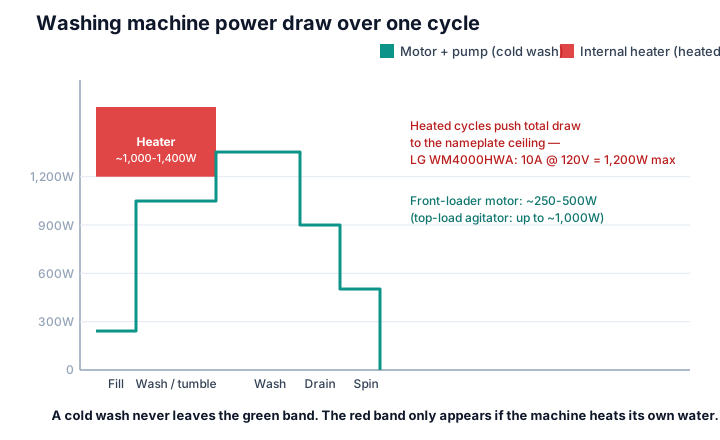
The two spec checks before you plug in
Check 1 — continuous output vs. nameplate. Your station’s rated AC output must exceed the washer’s nameplate maximum. A 1,800W station (EcoFlow DELTA 2, BLUETTI AC180, Anker SOLIX C1000 all rate 1,800W continuous) clears both example washers above with headroom. A 600W-class unit does not, no matter how big its battery is — the inverter shuts down the moment the washer’s spin motor kicks in. Note that EcoFlow’s X-Boost lets the DELTA 2 stretch to 2,200W for resistive loads, but running a motor at the boosted ceiling is a last resort, not a plan.
Check 2 — startup surge. Traditional belt-drive and agitator motors briefly pull roughly 2–3× their running watts when starting — the same inrush behavior as a well pump or freezer compressor, just larger. Published sizing guides put typical washer startup spikes at 1,050–3,500W depending on motor type. Modern front-loaders with inverter direct-drive motors (LG’s AI DD, for instance) ramp up electronically and draw far less inrush — this is why front-loaders are the friendlier washer for battery power. Every station recommended below carries a surge rating of 2,400W or better, which clears a cold-water start with room to spare.
The loads-per-charge formula
Runtime math works differently for a washer than for a chest freezer. A freezer runs for days; a washer runs for about an hour per load. So instead of hours, you want loads per charge:
Loads per charge = (Battery Wh × 0.95 × 0.85) / Energy per load (Wh)

  0.95 = LiFePO4 usable-capacity factor
  0.85 = inverter conversion loss (AC output)
The variable that matters is energy per load, and it splits into three regimes:
- Cold wash, front-loader: the motor and pump do all the work — roughly 0.3–0.5 kWh per cycle.
- Cold wash, top-load agitator: similar or slightly more, because the agitator gearbox and bigger motor offset the simpler design — roughly 0.3–0.5 kWh.
- Heated wash (any machine that heats its own water): the internal element dominates. Expect 1.5–3 kWh per load, right up against what a 1,000Wh battery physically contains after losses.
These are typical ranges compiled from nameplate data and published appliance energy documentation — your machine’s manual and the ThinQ-style energy tracking in its app can pin down the actual figure.
Loads per charge, by power station size
Applying the derating formula (usable Wh ≈ Wh × 0.8075) with a 0.4 kWh cold load and a 2 kWh heated load:
| Power station | Usable Wh | Cold wash loads | Heated wash loads |
|---|---|---|---|
| Bluetti AC180 (1,152Wh) | ~930 | ~2 | ~0.5 |
| EcoFlow Delta 2 (1,024Wh) | ~827 | ~2 | ~0.4 |
| Anker SOLIX C1000 (1,056Wh) | ~853 | ~2 | ~0.4 |
| Bluetti AC200P (2,000Wh) | ~1,615 | ~4 | ~0.8 |
| Anker SOLIX F3800 (3,840Wh) | ~3,100 | ~8 | ~1.6 |
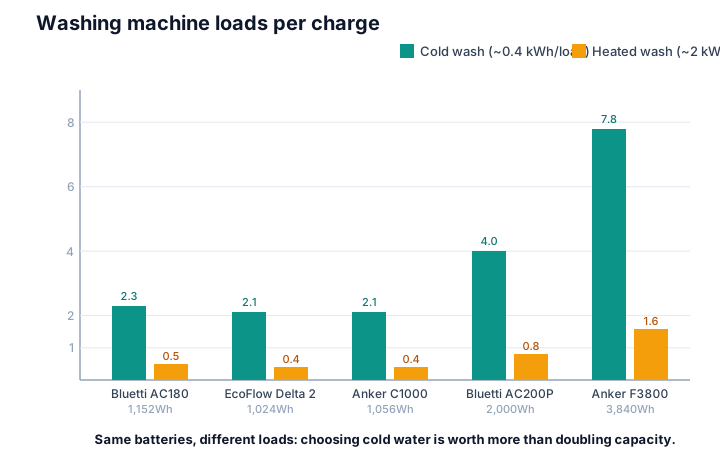
Read the heated-wash column honestly: on a heated cycle, a 1,000Wh-class station cannot even finish one load. That isn’t a defect — it’s physics. Heating water takes roughly ten times the energy of moving it. If your laundry plan involves warm or sanitize cycles, you need 3kWh+ of storage, and even then you’re getting one or two loads.
Cold water is the whole game
Every practical tip flows from one fact: the heater is the only component that can wreck the math, and on most machines you control whether it runs.
- Select cold/cold on the temperature dial. Most US washers fill from your home’s hot and cold supply lines — on a top-loader, “warm” just means mixing water from your (unpowered) water heater tank, which the washer itself barely heats. The internal-heater problem lives mainly in front-loader sanitize, steam, and “extra hot” cycles. Read your manual’s cycle chart: if a cycle name includes “sanitary,” “sanitize,” “steam,” or “allergen,” assume the heater runs.
- Skip pre-wash and extra rinse. Each extra fill-and-drain pass adds motor and pump runtime for marginal benefit — in an outage you’re optimizing for energy, not whitest whites.
- Wash full loads, back to back. Inverter losses are fixed per hour of use; batching loads squeezes more laundry out of the same usable watt-hours. If the station supports pass-through charging, plugging in solar between loads extends this further (more below).
- Use the highest spin speed. More water spun out now means faster drying later — relevant if you follow this with a line-dry or a gas dryer rather than an electric one.
One appliance that does not fit this article: the electric dryer. Its 240V heating element pulls 4,000–5,600W on a circuit no portable power station supplies. A gas dryer (120V drum motor, ~300–700W) runs fine alongside a washer on a 1,800W station — just not simultaneously with the washer’s startup moment.
Recharging between loads: the solar multiplier
Laundry is bursty, not continuous — a washer draws hard for an hour, then sits idle while the load is transferred or hung. That idle window is a free recharge opportunity: a 400W solar array in decent sun puts roughly 1.2–1.6 kWh back into a LiFePO4 station across a sunny afternoon (input ratings and real-world derating applied). That’s one to three extra cold loads per day, indefinitely, for as long as the weather holds.
A 2,000Wh station plus a 400W panel is the practical sweet spot for a multi-day outage: four cold loads on the first battery charge, then solar-topped reloads daily. If you’re sizing a whole-outage system rather than a laundry-only one, our runtime data across 7 critical devices shows how washer energy compares with the fridge, freezer, and furnace loads you’d be running first — because honestly, laundry is never load priority one.
Where laundry sits in the outage priority list
Worth saying plainly: in a genuine emergency, stored energy goes further spent on refrigeration, communications, and heat than on laundry. A family of four generates maybe one washer load a day; three cold loads consume roughly 1–1.5 kWh — comparable to keeping a fridge and router alive for most of a day. The realistic playbook for the first 24–48 hours of an outage is to not run the washer at all, then start doing cold loads once the essentials are proven stable and solar input is confirmed.
Where it does make sense early: households with infants (cloth diapers), medical or continence-care needs, or any situation where hygiene is a health issue rather than a comfort issue. And off-grid cabins and tiny homes, where laundry is simply part of the daily energy budget and gets sized in from the start. If you’re building that system, the F3800-class expandable units are the platform for it.
Two operational rules when you do run it:
- Start the washer with nothing else on the inverter. A fridge compressor kicking in at the same moment as the drum motor is the classic double-surge that trips an otherwise-adequate station. Sequence your heavy loads.
- If it trips at startup, the station isn’t broken. The surge ceiling was hit; the fix is a higher-rated unit, not a different cable or a support ticket.
Pure sine wave: yes, and here’s why it matters more than usual
Modern washers are appliances with computers in them — electronic control boards, pressure sensors, and increasingly variable-speed inverter motors. All of that electronics expects a clean pure sine wave. A modified-sine inverter can cause control boards to log errors, cycles to restart mid-wash, or motors to run hot. Every station recommended in this guide outputs pure sine wave; don’t run any computerized appliance from anything else.
Picks by scenario
Confirm your washer’s nameplate amps first (label or manual), then match to the biggest scenario that fits.
One to two loads to ride out a short outage → Bluetti AC180 / EcoFlow Delta 2 / Anker SOLIX C1000
All three rate 1,800W continuous with surge headroom above a washer’s startup spike, and each delivers ~2 cold loads per charge with capacity left for the fridge. The DELTA 2’s fast AC recharge (0–80% in 50 minutes per EcoFlow’s specs) is a quiet advantage when grid power flickers back on between loads. If your laundry area is far from where you’d stash a 30+ lb unit, the lighter C1000 earns its name.
Multi-day outage with solar → Bluetti AC200P
Four cold loads on charge, day one, then 400W of solar keeps the laundry going indefinitely. The AC200P’s 2,000W continuous and 4,800W surge rating (per Bluetti’s spec sheet) shrug off even a top-loader’s startup inrush while the fridge runs on the other circuit — sequence the starts and it all coexists.
Whole-home platform, laundry included → Anker SOLIX F3800
At 3,840Wh expandable and 6,000W continuous, the F3800 is sized for washer plus fridge plus freezer plus lights simultaneously — the configuration where laundry stops being a special event and just happens. Eight cold loads per charge, expandable to 12kWh+ with extra batteries, and pair it with solar for the indefinite version.
A note on the brands
The pure-sine stations here — Bluetti, EcoFlow, Anker SOLIX — publish continuous and surge output specs prominently, and it’s worth reading both rather than the headline number: for a washer, continuous output must clear the nameplate ceiling (typically ~1,200–1,300W for full-size machines), and surge must clear the motor’s 2–3× startup inrush on belt-drive machines. All the units above clear both bars for a cold-water wash; none of them clears a heated-wash energy budget on a single 1,000Wh-class charge, which is the real constraint to plan around.