
How Long Will a Power Station Run a Garage Door Opener?
A garage door cycle uses only ~4Wh - the real cost is 24/7 standby. Cycle counts for 256-3,840Wh stations, the 800-1,400W startup surge, and sizing.
The short answer: far longer than almost any other motor load in the house — because a garage door opener barely runs at all. The door motor pulls 300–600W while the door moves, but it only moves for 10–15 seconds per opening or closing. One full open-and-close cycle therefore consumes roughly 3–5 watt-hours — about what a 55-inch TV burns in two minutes. Even accounting for the opener’s real battery cost, which is not the motor but the 3–8W control board that idles 24 hours a day, a 1,000Wh power station delivers roughly 200 door cycles or about five days of typical outage duty. A 2,000Wh unit stretches past 400 cycles and eleven days. The one genuine constraint is not runtime but the startup surge: for a fraction of a second the motor can spike to 800–1,400W, so the power station’s inverter needs real headroom — which every mid-size station has and most pocket-size ones do not.
This page runs the honest math: what a garage door opener actually draws in each of its four states (standby, running, surge, and the courtesy-light tail), the horsepower-to-watts illusion that trips up sizing, the cycle-count table for every common battery size, and the two failure modes specific to this load — the always-on standby drain and the built-in backup battery that runs out precisely when you need it. It is part of our running “how long will it run” series alongside the chest freezer, the well pump, and the full runtime data table.
The free fallback first: every residential opener has a manual release cord — a red handle hanging from the trolley. Pull it (with the door closed) and the door disconnects from the motor entirely, operating by hand. That costs zero watt-hours. The power station is not for making the door openable; it is for making the door openable remotely, safely, and without leaving your car — which during a storm or a dark driveway is a real difference.
What a garage door opener actually draws (four states)
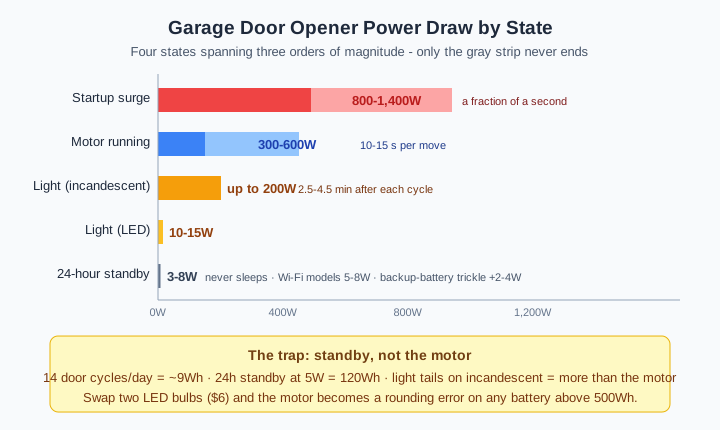
A garage door opener is not one load but four, and they differ by three orders of magnitude. Sizing correctly means knowing which state you are budgeting for:
| State | Typical draw | Duration | What’s active |
|---|---|---|---|
| Standby | 1–5W (basic) / 5–8W (Wi-Fi models) | 24h/day | Logic board, receiver, safety sensors |
| Startup surge | 800–1,400W | fraction of a second | Motor overcoming door inertia |
| Running | 300–600W | 10–15s per move | Motor moving the door |
| Courtesy light | 10–15W (LED) / 100–200W (incandescent) | 2.5–4.5 min auto-off | Opener bulb after each cycle |
| Backup-battery trickle | +2–4W | 24h/day | Charging the built-in 12V pack |
Figures compiled from manufacturer spec sheets for current 1/2–3/4 HP residential openers (Chamberlain, LiftMaster, and Genie units list 325–450W running draw on their published specifications) and standby-power measurements in the Lawrence Berkeley National Laboratory standby database tradition (garage door openers: 2–8W). Actual surge depends heavily on door weight, spring balance, and opener age — a poorly balanced two-car door forces the motor to work harder and can push both surge and running draw above the ranges above.
Three things in this table reshape how you think about the load. First, the motor’s contribution is trivial: at ~450W for ~25 seconds of total movement per full cycle, one open-and-close costs about 3Wh of energy. Run the door fourteen times a day — the average logged across household openers during Hurricane Beryl recovery — and the motor accounts for under 10Wh/day. That is a rounding error on any battery above 500Wh.
Second, standby is the real cost. The control board, remote receiver, and safety-photo-eye circuit never sleep. At a typical 5W, that is 120Wh per day — a dozen times what the door motor itself consumes. A Wi-Fi-connected opener with a battery-backup pack idles at 8–12W, or 200–290Wh/day, which single-handedly bounds how long even a large battery lasts on this circuit. The opener is the rare appliance where the “off” state costs more over an outage than the “on” state.
Third, the light is a sleeper line item. Every cycle triggers the courtesy light for the auto-off interval. An LED bulb adds under 1Wh per cycle; a 100W incandescent adds 4–7Wh per cycle and can momentarily push the inverter’s total load. If the opener still has its original bulbs, swapping two LEDs is the cheapest runtime upgrade in this entire series.
The horsepower illusion: 1/2 HP is not 373 watts
Opener motors are rated in horsepower, and the naive conversion (1 HP = 746W) suggests a 1/2 HP opener draws ~373W. That number is close enough to be dangerous. Horsepower describes lifting capacity at the output shaft, not electrical input draw — and the relationship between them is not linear across designs. Modern DC-motor openers (most Chamberlain, LiftMaster, and Genie units sold today) ramp up smoothly and often draw less than their AC-motor ancestors while delivering the same rated HP; older AC units pull a harder starting spike.
For planning purposes, ignore the HP label and use the observed ranges: 325–450W running for common spec-sheet units (Genie SilentMax 325W, Chamberlain belt-drive 350W, LiftMaster 8550WLB 400W), with heavier doors and screw-drive designs at the top of the 300–600W band. And note what the label does tell you: a 1/2 HP unit suits an 8-foot single door, a 16-foot double door wants 2/3 to 3/4 HP, and insulated or wood doors want a 1 HP DC motor — but none of that changes the energy math much, because the motor runs for seconds, not minutes.
The runtime formula, applied to a burst load
Same derating chain as the rest of this series — but with a twist. Because the motor runs for seconds, its draw barely dents the battery. What matters is cycles and standby-days:
Usable Wh = Battery Wh × 0.95 × 0.85
  0.95 = LiFePO4 usable-capacity factor
  0.85 = inverter conversion loss (AC output)

Cycles ≈ Usable Wh / 4Wh per full open+close (LED light)
Outage days ≈ Usable Wh / ~150Wh per day (12 cycles + 24h standby + light tails)
The 150Wh/day planning figure decomposes as: ~25Wh of door movement (12 cycles at ~2Wh per move), ~120Wh of standby (5W × 24h), and a few watt-hours of LED light tails. A Wi-Fi opener with battery backup runs ~200Wh/day and shaves the day counts below by about a quarter.
| Battery | Usable Wh | Door cycles | Outage days (~150Wh/day) |
|---|---|---|---|
| 256Wh mini | ~211 | ~50 | ~1.4 days |
| 512Wh | ~422 | ~105 | ~2.8 days |
| 1,000Wh | ~808 | ~200 | ~5 days |
| 2,000Wh | ~1,655 | ~415 | ~11 days |
| 3,000Wh | ~2,478 | ~620 | ~16 days |
| 3,840Wh | ~3,109 | ~775 | ~21 days |
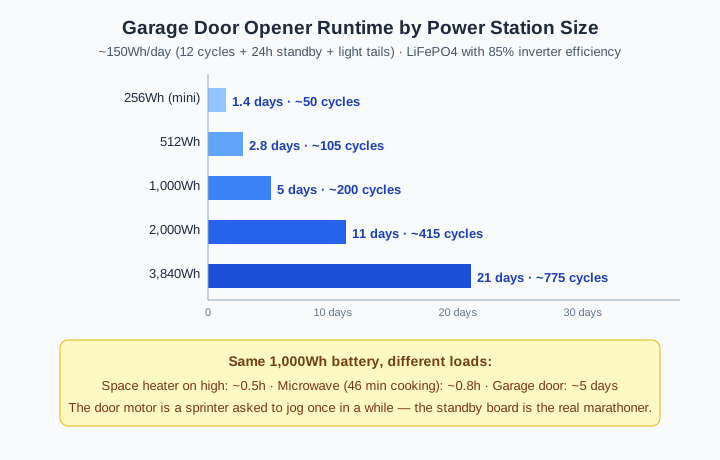
Read that table the outage-planner’s way: even a 512Wh compact station covers a typical 1–3 day outage with the door fully functional, and the reason is that the door motor is a sprinter asked to jog once in a while. The battery’s silent companion — that 5W board — is the marathoner who never stops. This is why the garage door opener pairs so naturally with other garage loads: the same chest freezer sitting next to the opener draws 30–60W continuously and will exhaust the battery long before the door does, so size the station for the freezer and treat the opener as nearly free.
The surge constraint: what the inverter must absorb
Runtime aside, the opener imposes one hard electrical requirement: the inverter must tolerate the startup spike without tripping. When the motor engages, inrush current briefly reaches 800–1,400W — and up to ~1,500W for a heavy or poorly balanced door. If the power station’s surge rating (the short-overload headroom above its continuous rating) cannot absorb that spike, the inverter’s protection trips, the display beeps, and the door stalls mid-cycle.
What this means in practice:
- 1,000Wh-class stations (1,800W+ continuous, 2,000W+ surge): no issue. The spike sits well inside their headroom. EcoFlow DELTA 2, Anker SOLIX C1000, and Bluetti AC180 all absorb it trivially.
- 512Wh compacts (500–700W continuous): check the surge spec first. Many handle brief overloads; some trip at exactly this load class. Verify the manufacturer’s published surge figure before relying on one.
- 256Wh minis (200–300W continuous): marginal. The running draw alone (300–600W) exceeds the continuous rating, and the surge far exceeds it. Do not plan on a mini for the garage door.
Also worth knowing: openers are sensitive electronics plus a motor. A pure sine wave inverter is the safe default; modified-sine output can cause erratic behavior in the opener’s control board. Every mainstream LiFePO4 power station outputs pure sine wave, so this is only a concern with budget generic inverters.
The built-in backup battery is a buffer, not a plan
Many openers sold since the late 2010s include their own small 12V sealed lead-acid backup pack — mandatory on all new residential openers sold in California since SB 969 took effect in 2019. The manufacturer documentation for these packs (LiftMaster’s 8500W series, among others) rates them for roughly 20–50 cycles before exhaustion. That sounds generous until you count a real outage day: leave for work, come home, errands, trash, school pickup — six round trips is twelve cycles. The pack is empty by the end of day two, and hot-garage heat cycles degrade lead-acid chemistry further, so a three-to-five-year-old pack may deliver far less than its rating.
The correct mental model: the built-in pack is a 24-hour buffer that buys you time to pull the manual release cord — not an outage solution. A power station, by contrast, keeps the opener on AC power indefinitely, keeps the built-in pack charged (its +2–4W trickle is already in the standby math above), and lets the family keep using remote controls and keypad entry, which the manual-cord mode disables. For households with a second car behind the closed door, that difference is the whole point.
Sizing picks and the mistakes to avoid
Because the door motor is a burst load, the sizing decision is really about three things: surge headroom, standby watts, and what else shares the circuit. The recurring mistakes:
- Mistake 1: sizing for the motor’s horsepower. A “1/2 HP = 373W, so a 500W station is fine” calculation ignores the 800–1,400W surge. The inverter trips on day one and the purchase looks broken. Filter stations by surge rating, not continuous rating.
- Mistake 2: forgetting that standby never sleeps. Budgeting only cycle energy (~25Wh/day) overstates runtime by a factor of six. The 24/7 board draw is what turns “hundreds of cycles” into “five days.”
- Mistake 3: planning the opener in isolation. The garage circuit usually feeds a freezer, a shop light, or a gate. The opener costs almost nothing; the roommate loads decide the battery size. Run the full list through the Runtime Calculator.
- Mistake 4: keeping incandescent opener bulbs. Two 60–100W bulbs that fire on every cycle add more daily energy than the door motor itself. Two LED bulbs cost $6 and erase it.
For most households the decision collapses to one answer: a 1,000Wh-class station (EcoFlow DELTA 2, Anker SOLIX C1000, Bluetti AC180 — all 1,800W+ continuous, all pure sine wave, all LiFePO4) runs the door for a full week of outage duty and still has capacity for the freezer and phones. Step up to 2,000Wh+ only when refrigeration or heat shares the plan. All brands in this space publish detailed capacity, output, and surge specifications in their official documentation — the opener’s needs sit comfortably below every mid-size unit’s limits.